
This page provides a deeper understanding of the DoI model and how it can be used in the development of a a successful professional development plan for educators.
Diffusion of
Innovations
Innovations
Diffusion is the process by which an innovation is communicated through certain communication channels over time among the members of a particular social system. Diffusion is a special type of communication that focuses on the way a new innovative messages are spread through one's social system.
Each member of that social system follows the following 5-Step process in which they evaluate the innovation:
1) Knowledge – a person becomes aware of an innovation and has some idea of how it functions
2) Persuasion – a person forms a favorable or unfavorable attitude toward the innovation.
3) Decision – a person engages in activities that lead to a choice to adopt or reject the innovation.
4) Implementation – a person puts an innovation into use.
5) Confirmation – a person evaluates the results of an innovation-decision already made.
Each member of that social system follows the following 5-Step process in which they evaluate the innovation:
1) Knowledge – a person becomes aware of an innovation and has some idea of how it functions
2) Persuasion – a person forms a favorable or unfavorable attitude toward the innovation.
3) Decision – a person engages in activities that lead to a choice to adopt or reject the innovation.
4) Implementation – a person puts an innovation into use.
5) Confirmation – a person evaluates the results of an innovation-decision already made.
Arkova Scott.etpd © 2011
DoI: Defined
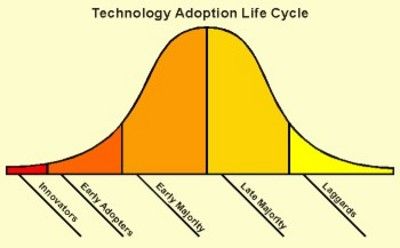
Time is involved in diffusion by the rate in which an individual adopts the new innovation in the social system. There are five adopter categories, of the members of a social system based on the rate they will utilize and integrate an innovation. Below is a description of the 5 adopter categories and a brief recommendation of the type of educational technology professional development (ETPD) approach for the various members within their set social system.
Communication Channels
Communication is the way members of a social system create and share information with one another in order to reach a mutual understanding. A communication channel is the means by which messages get from one individual to another.
Time
Innovations
Social System
Everett Rogers, the author of the 1962 book, Diffusion of Innovations, offers the following description of an innovation: “An innovation is an idea, practice, or project that is
perceived as new by an individual or other unit of adoption” (Rogers, 2003, p. 12).
An innovation may have been invented a long time ago, but if individuals perceive it as new, then it may still be an innovation for them. The characteristics which determine an innovation's rate of adoption are:
perceived as new by an individual or other unit of adoption” (Rogers, 2003, p. 12).
An innovation may have been invented a long time ago, but if individuals perceive it as new, then it may still be an innovation for them. The characteristics which determine an innovation's rate of adoption are:
They serve as role-models for many other members of the social system. Early adopters are instrumental in getting an innovation out to the critical masses, so in a successful ETPD training session,those are the individuals to persuade and influence regarding the new innovation!!


1) Relative advantage: the amount a person discovers a new innovation to be better than the last adopted innovation.The more beneficial an innovation then the faster the adoption rate will be.
2) Compatibility: the amount an innovation is seen as being consistent with the existing values, past experiences, and needs of potential adopters. An innovation that is not consistent with the values and norms of a social system will not be adopted as quickly as one that is compatible.
3) Complexity: the amount an innovation is seen as difficult to understand and use. New ideas that are easier to understand are adopted quicker than innovations that requires the adopter to develop new skills and understandings.
4) Trialability: the amount an innovation may be experimented with on a limited basis. Innovations that can be tried in small intervals will generally be adopted faster.
5) Observability:the amount an adopter sees results of an innovation with others in the social system. This observation process will stimulate discussion amongst the peers in the social system, which will eventually influence the potential adopter to utilize the innovation.


1. Innovators: The first ~2.5% of the members of a
social system to adopt a new tool, idea,or technique.They can understand and apply technical knowledge easily, and
they communicate most frequently with other innovators, often outside their local social system.
ETPD: The best suited approach to innovators is a training session that is minimally assisted and consists of, individualized learning and data-based inquiry.
2. Early Adopters: They are the next ~13.5% of a social system to adopt an innovation. Early adopters are known to others in the social system for successful
but discreet use of new implements, methods, or ideas, and therefore often serve as role models for many others. They tend to be the opinion leaders in social systems with a heightened focus on quality of that innovation.
ETPD: Large- and small-group problem-solving training sessions, sharing
best practices, mentoring, and a lesson study should be the best approach for this group.
3. Early Majority: They are members that comprise of the next ~34% to adopt an innovation. Early majority members are known for interacting frequently with
colleagues. They do not often hold leadership positions within the social
system, but instead, their primary role is to provide connections between the different interpersonal networks within the community. It takes early majority
members longer to decide to try a new tool, technique, or idea than early
adopters and innovators but once they've caught on then it spreads very quickly to the other members of the social system.
ETPD: Large-group and small-group interaction and problem-solving sessions,
and a collaborative learning session that has a mix of all of the various adopter categories.
4. Late Majority: Members in a social system that comprise of the next ~34% to
adopt a particular innovation. This group of individuals are quite skeptical of new ideas, methods, and tools, and this skepticism makes them more cautious about
trying an innovation than any of the groups previously mentioned. They often will only adopt an innovation out of necessity or strong influence from their peers.
ETPD: Demonstration or awareness sessions, hands-on workshops, organized classroom visits and peer coaching, and lesson study.
5. Laggards: These members are the last ~16% of the social system. Laggards
are the most traditional of all of the members of the social system. They are extremely cautious in the exploration of new ideas, tools, and techniques. The past is what they refer to the most so they often serve a very important function for the social system: they remember its history and provide reference to its future.
ETPD: Individualized assistance, individualized learning plans and individually prescribed and managed instruction.

There are two main channels used in communication:
1) Mass media channels are used to help create the knowledge of an innovation.
2) Interpersonal channels are used to help form the changing attitudes toward an innovation. This process assists with the decision to adopt or reject a new idea.
Most individuals in a social system evaluate usually base their opinions on an innovation, by the feedback given to them from their peers, not on the based on scientific research by experts.
Here is a visual representation of Roger's Diffusion of Innovation Adoption Rate.
A social system is defined as a set of interrelated units that are engaged in joint problem-solving to accomplish a common goal. The members or units of a social system may be individuals, informal groups, organizations, and/or subsystems. The aforementioned adoption rate categories demonstrate the attitudes and behaviors in each social system. The most critical thing to know about social systems are the key members that will help getting the use of the innovation out to the critical masses. Identify the early adopters in the training group because they are then opinion leaders.